
Key takeaways
- Timing comes first. After a Michigan sheriff’s sale, most homes have a six-month redemption period, and the former owner can keep living there until it ends.
- Abandoned homes can move faster. When the lender follows the state’s abandonment steps, redemption can shrink to one month or 30 days.
- People still inside go through the courts. After redemption, the buyer files an eviction case, and the sheriff removes anyone who stays, along with their belongings.
- The cleanout clears everything, inside and out, and ends broom-clean, with before-and-after photos and a completion summary for the file.
A foreclosure cleanout empties a bank-owned or auction-bought house of everything the last occupants left, from furniture and trash to a fridge full of spoiled food and the shed out back. In Michigan, the work usually can’t start until the redemption period after the sheriff’s sale has run out and nobody is living in the house anymore.
Our crew handles foreclosure and distressed property cleanouts for lenders, asset managers, investors, and realtors across Macomb, Oakland, and Wayne counties. If you’re not sure whether a house is ready to clear, start with the timeline below.
When can you legally clear a foreclosed house in Michigan?
A Michigan mortgage foreclosure that goes to a sheriff’s sale follows a set path. The sale notice runs in a local newspaper for at least four weeks and gets posted on the house, then the property is auctioned, usually to the lender.
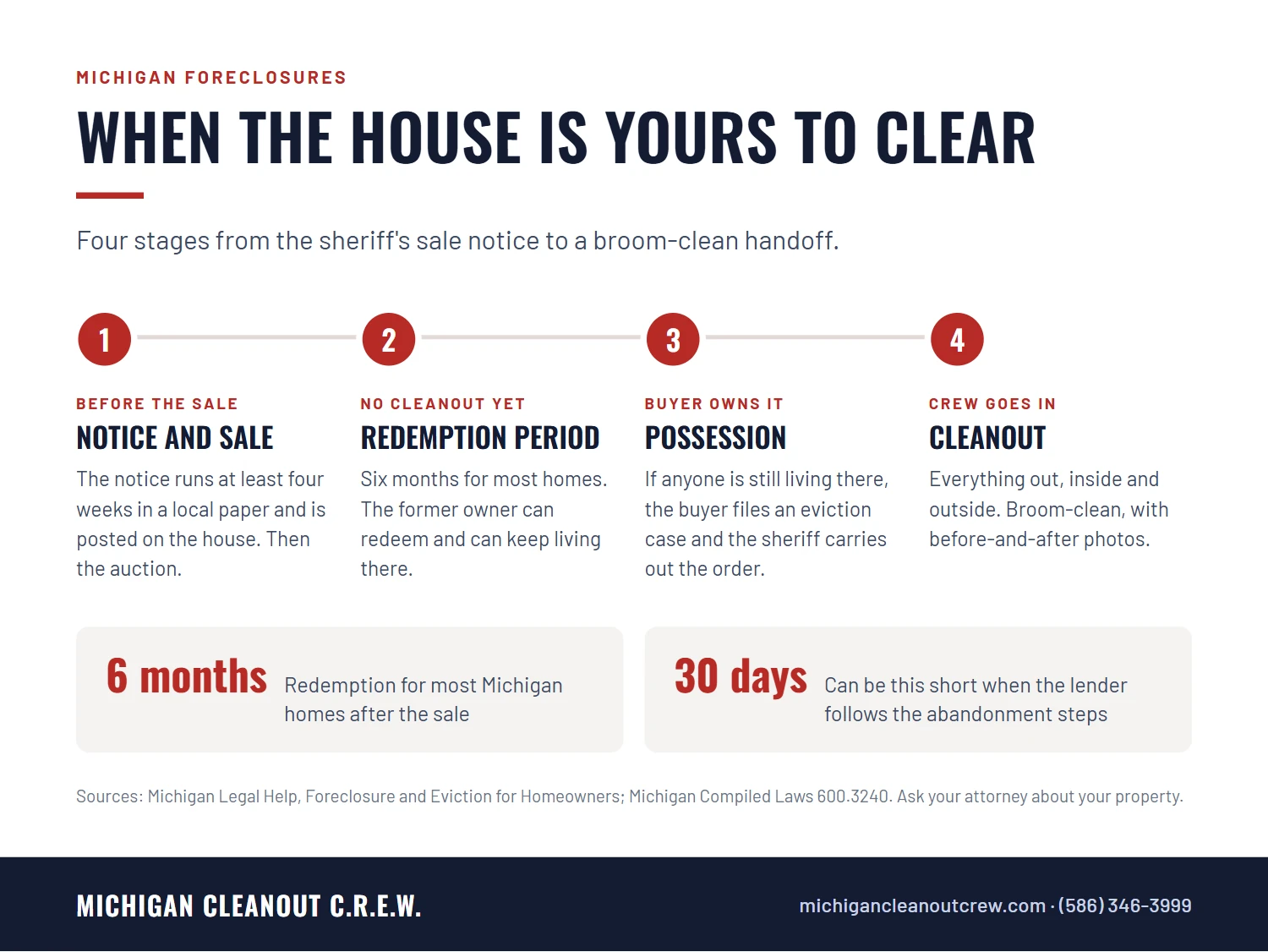
The auction starts the redemption period. During it, the former owner can still redeem the home by paying the sale price plus fees and interest, and can keep living there the whole time.
6 months
How long most Michigan homeowners have to redeem after a sheriff’s sale. The exact deadline is on the certificate of sale, which you can get from the county Register of Deeds.
Source: Michigan Legal Help, Foreclosure and Eviction for Homeowners
Until redemption ends, the buyer’s main right is to inspect the house, with at least 72 hours’ notice. If an inspection finds damage that isn’t fixed within 7 days of the buyer’s notice, the buyer can go to court to take possession early.
Which redemption period applies
Six months covers most homes. Michigan’s redemption statute, MCL 600.3240, sets the other periods by property type and by how much was still owed on the loan.
| Property | Redemption period |
|---|---|
| Home of 1 to 4 units, owing more than two-thirds of the original loan when foreclosure was noticed | 6 months |
| Home of 1 to 4 units where the lender recorded an abandonment affidavit before foreclosure began (section 3241) | 1 month |
| Home the lender inspected and posted as abandoned, with no written reply from the owner (section 3241a) | 30 days after the sale, or when the owner’s reply window closes, whichever is later |
| Commercial, industrial, or more than 4 units | 6 months |
| Agricultural property | 1 year |
| Anything else, including a home owing two-thirds or less of the original loan | 1 year |
The abandoned-house shortcut
Lenders have a faster route for a house nobody lives in. Under section 3241a, the lender inspects the house, finds nobody living there or planning to, posts a notice at the property, and sends one to the owner by certified mail.
If the owner doesn’t reply in writing to say the home is not abandoned, their redemption rights end 30 days after the sale or when the reply window closes, whichever is later. If you’re a buyer or agent counting on that date, have your attorney confirm the lender finished every step before you book a crew.
After redemption: occupants, tenants, and belongings
Once the redemption period ends, the buyer owns the house. If someone is still living there, the buyer files an eviction case. When the court orders the eviction, the occupants usually have 10 days to leave.
If they stay past that, the court orders the sheriff to evict them and remove their belongings. Your cleanout crew comes in once the court officer is done.
Some buyers avoid court with a cash-for-keys deal, where the occupant agrees to move out by a set date in exchange for money. Put the deal in writing, spell out what the occupant takes and what stays, and have your attorney review it.
Landlords with their own tenants follow the same basic rule. A landlord can’t change the locks or haul out a tenant’s things without an eviction order carried out by a court officer. Once the unit is legally yours again, our rental turnover cleanouts can get it back on the market in days.
Tenants in a foreclosed rental
A tenant isn’t automatically out when redemption ends. Michigan Legal Help’s guide for tenants in foreclosed properties says many get 90 days after the redemption period ends or the rest of their lease, as long as the tenancy is legitimate and the tenant isn’t the former owner’s parent, child, or spouse.
If you bought an occupied rental at auction, build that into your cleanout date. Talk to your attorney before you give anyone notice.
Belongings left in a vacant house
Then there’s the house the occupants walked away from, still full of furniture, clothes, and paperwork, and no court order that covers what’s left. What you owe the former owner for those things depends on the facts, so talk to your attorney before anything personal goes in a dumpster.
Start by photographing every room as you found it, and keep personal papers, photos, IDs, and anything that looks valuable apart from the trash. Our crew treats abandoned belongings as unknown contents that need careful sorting before anything moves.
What a foreclosure cleanout covers
A foreclosure cleanout, often called a trash-out, takes the property down to empty and broom-clean. On every distressed property, we handle the full removal room by room and floor by floor, with no skipped areas and no partial jobs:
- Furniture, mattresses, clothing, and personal belongings
- Appliances, including refrigerators and freezers
- Basement, garage, and attic contents
- Trash, junk, carpet, and light tear-out debris
- Sheds, decks, and debris from the yard or acreage
- Hot tubs and swing sets
On a distressed property, the outside is half the job. On past jobs we’ve torn out and hauled a rotted deck, leaving the ground clean and level, and taken down a failing shed, sorted its contents, and cleared the lot.
Items with resale or donation value are identified before disposal and handled through our vendor and resale network, which can offset part of the cost. Sorting before hauling is how we run every property cleanout, foreclosed or not.
Condition surprises in a house that sat empty
We walk the full property before quoting and flag condition concerns up front. In a house that sat empty, expect some of these.
Spoiled food
If the power was shut off with food inside, the refrigerator and freezer can be the worst part of the house. Keep the doors closed, point them out at the walkthrough, and let them leave with the other appliances.
Pests
Mice and insects move into a quiet house, and mattresses and upholstered furniture are where they settle. If you spot droppings or bugs, mention them, since pest control may need to happen before or after the cleanout.
Water damage
A Michigan house that sat through a winter without heat can have burst pipes, a wet basement, and mold behind the furniture. Soaked carpet and padding change the scope, so they belong in the walkthrough, where they can be priced in.
Hazards and packed houses
Paint, chemicals, propane tanks, old fuel, and sometimes firearms or ammunition turn up in garages and basements. Our crew sets them aside and helps coordinate safe local disposal.
A house packed floor to ceiling takes more sorting time, and once you open the doors it can look a lot like a hoarding cleanout. Mention it when you call.
Paperwork buyers and asset managers should keep
A clean file shows two things: that the property was legally yours to clear on the day it was cleared, and what condition it was in before and after. This is who usually handles each piece.
| Step | Who usually handles it | What goes in the file |
|---|---|---|
| Confirm the redemption period has expired | The buyer or asset manager, with their attorney | The certificate of sale from the county Register of Deeds |
| Check for tenants with a lease | The buyer, with their attorney | Any lease, plus the redemption end date |
| Remove anyone still living there | The sheriff, under a court eviction order | The eviction order |
| Decide what happens to belongings left in a vacant house | Your attorney | Their guidance, in writing |
| Clear the interior, outbuildings, and yard | The cleanout crew | The flat-rate quote and the invoice |
| Record condition before and after | The cleanout crew | Before-and-after photos and a completion summary |
On our jobs, before-and-after photos and a completion summary are available on every distressed property, for lenders, attorneys, or anyone who needs a record. Banks, asset managers, realtors, attorneys, and investors all stay in the loop without chasing us for updates.
Booking a foreclosure cleanout in Southeast Michigan
Every job starts with a free on-site assessment. We walk the full property, flag what we find, and give one flat-rate price that doesn’t change mid-job.
Walkthroughs usually happen within a few days of your call, and most projects begin within the week after you approve the quote. Most single homes take one to three days, and listing deadlines get priority scheduling.
If you can’t drive out, give us a lockbox code and we’ll keep you updated with photos. Once the house is empty, it’s ready for renovation, listing, transfer, or resale on your schedule.
Our service area covers Macomb, Oakland, and Wayne counties, with extended coverage toward Lansing, Ann Arbor, and Saginaw. In Detroit, that includes bank-owned, neglected, rental, and investment properties citywide.
Foreclosure cleanout FAQ
Can I clean out a foreclosed house during the redemption period?
Generally, no. The former owner can keep living there, and the auction buyer doesn’t own the property until redemption ends. If you have a reason to act sooner, such as damage, talk to your attorney first.
Who do you work with on foreclosures?
Banks and lenders, asset managers, investors and flippers, realtors and brokers, and estate attorneys. We also work with property managers and municipalities dealing with abandoned or code-compliance properties.
Are you licensed and insured?
Yes. Michigan Cleanout C.R.E.W. is licensed, certified, and insured in the State of Michigan.
What does a foreclosure cleanout cost?
Volume, access, and labor set the price, so it comes after a free on-site assessment. You get one flat-rate number up front, and items with resale or donation value can help offset it. Send the address and your deadline when you request a quote.
Get a free on-site walkthrough
Tell us a little about the property and we’ll set up a free on-site walkthrough. No pressure, no obligation, and a clear flat-rate quote.