
Key takeaways
- Lead with safety. Start a hoarding cleanup by talking about the stove and the way out of the house, and use your loved one’s own words for their things.
- Skip the surprise purge. Clearing a home without consent causes real distress and breaks trust, and the clutter tends to come back anyway.
- Small, agreed wins add up. A clear stovetop or an open path to the back door is a real start, and it earns you the next room.
- The right crew works at the homeowner’s pace. Look for room-by-room sorting, discretion, the homeowner making every call, and a flat-rate quote after a free walkthrough.
The best way to start a hoarding cleanup for someone you love is slowly, and with their permission. Raise safety first and agree on one small area. From there, let them decide what happens to their things, whether the two of you tackle it or you bring in a crew.
Hoarding cleanups are the call we get most from Detroit. In a city full of brick bungalows and two-family flats that have stayed in one family for generations, a house can hold sixty years of someone’s life.
Why a home fills up in the first place
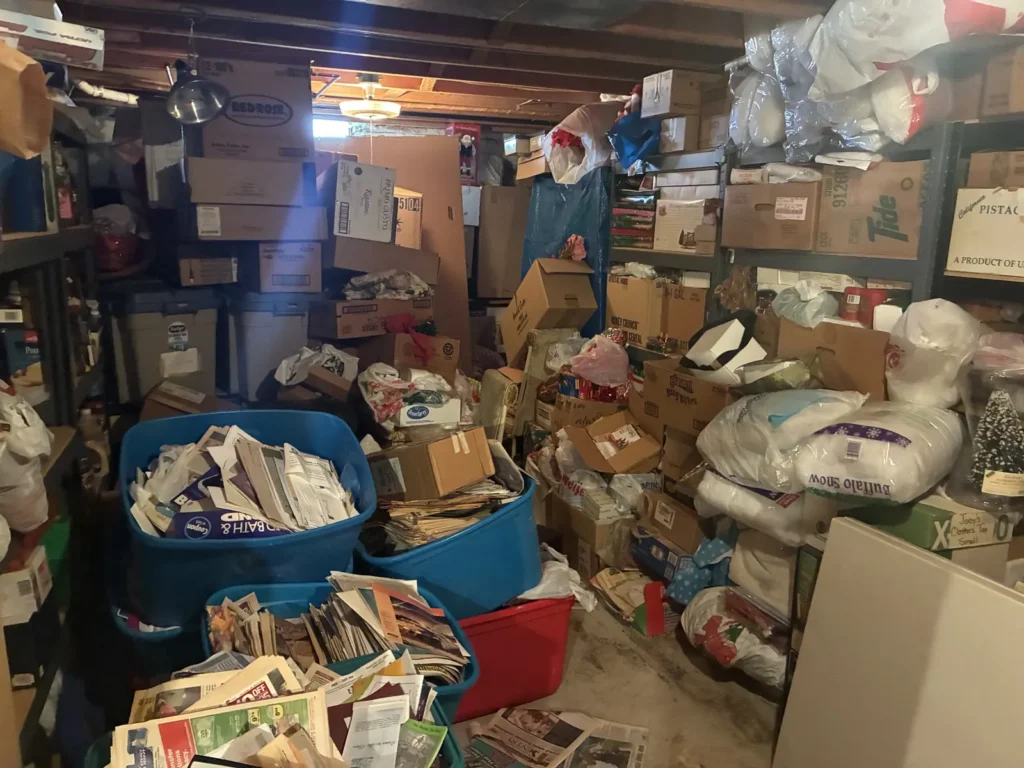
Nobody sets out to fill their home until they can’t use it. It usually starts with grief, an illness, or just feeling overwhelmed, and the piles build up over years. That’s why one weekend rarely undoes it.
When it reaches the level of a diagnosis, it’s called hoarding disorder. The American Psychiatric Association describes it as persistent difficulty parting with possessions, to the point where the clutter gets in the way of using the home, and says it tends to start early in life and grow more severe with each decade.
2.6%
The approximate overall rate of hoarding disorder, with higher rates for people over 60. Men and women are affected about equally.
Source: American Psychiatric Association, What Is Hoarding Disorder?
How to bring it up without wrecking the relationship
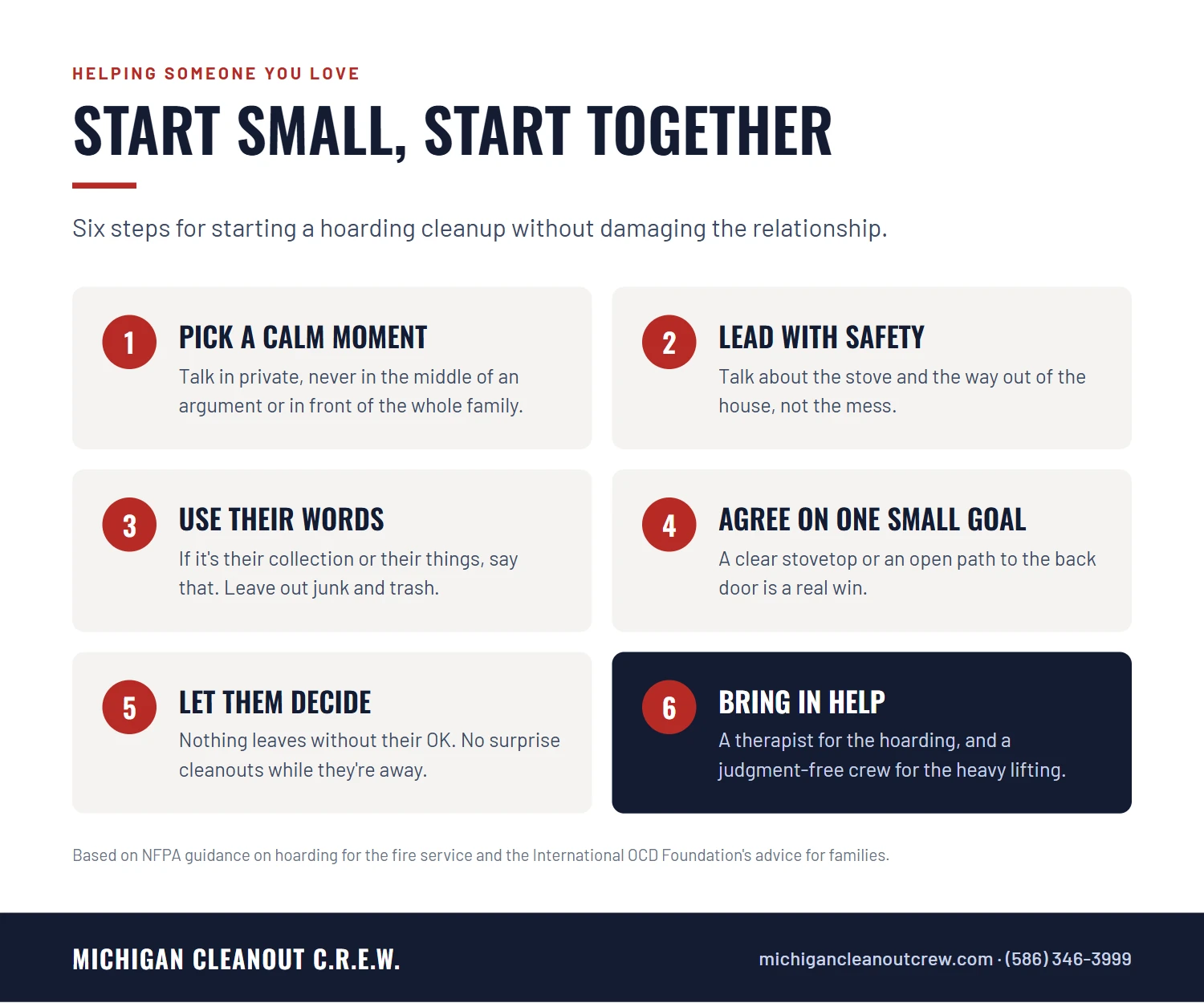
Pick a calm, private moment, never the middle of an argument or a holiday dinner with the whole family watching. Go in expecting the first of several conversations.
Then lead with safety. The National Fire Protection Association’s guidance on hoarding for the fire service advises showing concern for the person’s safety and building support for fixing fire and fall hazards, instead of insisting on an immediate, overwhelming cleanup.
Use their words, too. If your mom calls it her collection or her things, so do you, and the NFPA lists junk, trash, and even hoarding as words to leave out of the conversation.
The International OCD Foundation’s advice on how to help a loved one with hoarding disorder makes the same point from the mental health side. A worry about bottles piled near the stove is more likely to be heard than a speech about how nobody should live this way, and people tend to be more motivated by a safety plan they helped make.
What to say, and what to skip
| Instead of this | Try this | Why it works better |
|---|---|---|
| “This place is a disaster.” | “I worry about you getting out fast if there’s ever a fire.” | Safety concerns get heard where criticism gets tuned out. |
| “We need to throw out all this junk.” | “Can we clear your things off the stove today?” | Their words, one hazard, one small task. |
| Clearing a room while they’re in the hospital or away | Asking which corner they’d like to start with | Unwelcome cleanouts cause intense distress, and the clutter likely returns. |
| “You have to stop this.” | “What would you like to use this room for again?” | It points them toward how they want the home to work. |
| A deadline to clear the whole house by Sunday | One agreed goal, like a clear path to the back door | Building support for one fix beats an overwhelming cleanup. |
| Quietly paying for another storage unit | Making a plan for the storage unit together, a step at a time | Covering a storage bill can keep the cycle going, so ease off gradually, with their input. |
Listen more than you talk. The IOCDF recommends an approach called motivational interviewing, which lets the person reach their own solutions at their own pace, and it warns that this takes a lot of patience. Setbacks are normal, so judge progress by the overall direction across many visits.
Why a surprise cleanout backfires
It’s tempting to rent a dumpster, call the cousins, and clear the house while Dad is at a doctor’s appointment. Families do it out of love, but it rarely lasts.
The IOCDF says unwelcome cleanouts cause intense distress and can turn the person’s anger toward the relatives involved. The beliefs that filled the house are still there afterward, so within days or weeks the clutter is likely to start building again.
It also breaks trust. Someone who comes home to an emptied living room may not let you past the front porch again, and every conversation after that gets harder.
Start small and build on it
The first goal should be small enough that your loved one can say yes to it today. A path from the bed to the bathroom, or a back door that opens all the way, counts as a real win, and each one makes the next conversation easier.
Expect some clutter to stay for a while. The IOCDF calls a goal of zero clutter unrealistic, at least at first, and says families may need to accept a home that’s safer but still cluttered.
Work in short sessions and stop before anyone is worn out. One carload of things your loved one chose to donate is worth more than a dumpster full of things they’ll grieve over.
When it becomes a safety issue
Some homes can’t wait for months of gentle conversation. The NFPA warns that hoarding can be a fire hazard, that blocked exits often keep people from escaping, and that many people who hoard are hurt tripping over things or when piles fall on them.
Heavy piles add weight and fuel. The same NFPA guide notes that excessive fire loading can lead to collapse, putting firefighters at risk, and that people living next door can be affected quickly by smoke and fire, which matters in a city with as many two-family flats and close-set houses as Detroit.
Watch for these signs, especially once the furnace and space heaters are running for a Michigan winter:
- Doors that won’t open all the way, or a single narrow path through a room
- Things stacked on or near the stove, a space heater, or the furnace
- Tall piles that could topple onto someone
- Sagging floors, or heavy loads of paper and books on an upper floor
- Droppings, chewed boxes, or a smell that points to mice or insects
- Water stains, a musty smell, or mold, especially on boxes in a damp basement
If anyone’s life is in immediate danger, call 911. For everything else on that list, bring the specific hazard to your loved one first, and know that mold, pests, or structural damage may need a specialist alongside any cleanup.
What a professional hoarding cleanup looks like in Detroit
When your loved one is ready, or the safety risk won’t wait, a crew can take the physical work off the family. The right one treats the person living there with patience and zero judgment.
Here’s how a hoarding cleanup with our crew works, start to finish:
- Private walkthrough. We meet you or your family member at the home, walk what we can, and listen. It’s free, with no pressure and no lectures.
- One flat-rate quote. A clear price for the full scope, based on volume and condition, that doesn’t change mid-job.
- Room-by-room sorting. Keepsakes, valuables, and documents are recovered first. The homeowner makes the calls, and we keep the pace humane.
- Clear, sweep, breathe. Full removal and a deep sweep, with photo documentation if the family wants it.
We sort instead of shovel, because documents, cash, jewelry, and photos turn up in almost every hoarding cleanup, and everything we find goes to the family. Nothing leaves the house without a decision, and we flag any condition issues we find along the way.
Family members arrange these cleanups for a relative often, and we work with caseworkers too. Our before-and-after gallery shows real rooms our crew has cleared, with nothing staged.
Detroit’s east side is a short drive from our Macomb County base, and we can usually schedule a walkthrough anywhere in the city the same week you call. Our Detroit cleanout page covers the neighborhoods we work in.
If the home belonged to a parent who has died, the priorities shift toward paperwork and the estate. Our guide to cleaning out a parent’s house after a death walks through that order.
Help for the hoarding, and for you
A cleanup clears the house, but the habits that filled it are a separate job. The American Psychiatric Association says treatment can reduce the saving, collecting, and clutter that come with hoarding disorder, and it describes cognitive behavioral therapy as an effective treatment.
If your loved one is open to it, a therapist who works with hoarding is a good next step, and the IOCDF’s hoarding site has a directory for finding one by zip code. Even if they aren’t ready, a mental health professional can teach you the motivational interviewing approach.
Look after yourself, too. Family members often feel alone in this, and the IOCDF points families toward support groups as well as treatment.
Hoarding cleanup in Detroit: common questions
How much does a hoarding cleanup cost in Detroit?
The price comes down to volume, access, and the condition of the home, so we quote only after a free walkthrough. You get one flat-rate number before work begins, and it doesn’t change. You can also text photos to (586) 346-3999, and we can often give a rough quote from those.
Can I set up a cleanup for a parent who isn’t ready?
You can make the call, and families do it often. The homeowner still stays in control of every decision, so it goes best once they’ve agreed to at least a first room.
Will the neighbors know?
We keep it discreet. There are no lettered dumpsters sitting out for weeks, just a working crew that could be doing any cleanout.
How long does a hoarding cleanup take?
About a day for a garage, and up to a week for a full house. The walkthrough gives you a realistic timeline before anything starts.
Is a hoarding cleanup the same as junk removal?
No. Junk removal hauls what you point at, while a hoarding cleanup sorts first, so papers and valuables are found before anything goes. Our guide to whole-house cleanouts versus junk removal compares the two.
Do you cover all of Detroit?
Yes, citywide, plus Hamtramck, Highland Park, Harper Woods, and the Grosse Pointes. Beyond the city, we cover the rest of Macomb, Oakland, and Wayne counties.
Get a free on-site walkthrough
Tell us a little about the property and we’ll set up a free on-site walkthrough. No pressure, no obligation, and a clear flat-rate quote.