
Key takeaways
- Start with paperwork, not furniture. The first job in cleaning out a parent’s house is finding the will, deeds, titles, and account statements, which are easy to lose once boxes start moving.
- Family keepsakes come next. Photos, letters, and anything a relative wants get claimed and labeled before anything leaves the house.
- Most houses clear in one to three days once the family has made its decisions. Garages and single rooms are often done the same day.
- You don’t have to live nearby. A cleanout can run from a lockbox code, with photo updates at each decision point and a documented finish for the estate.
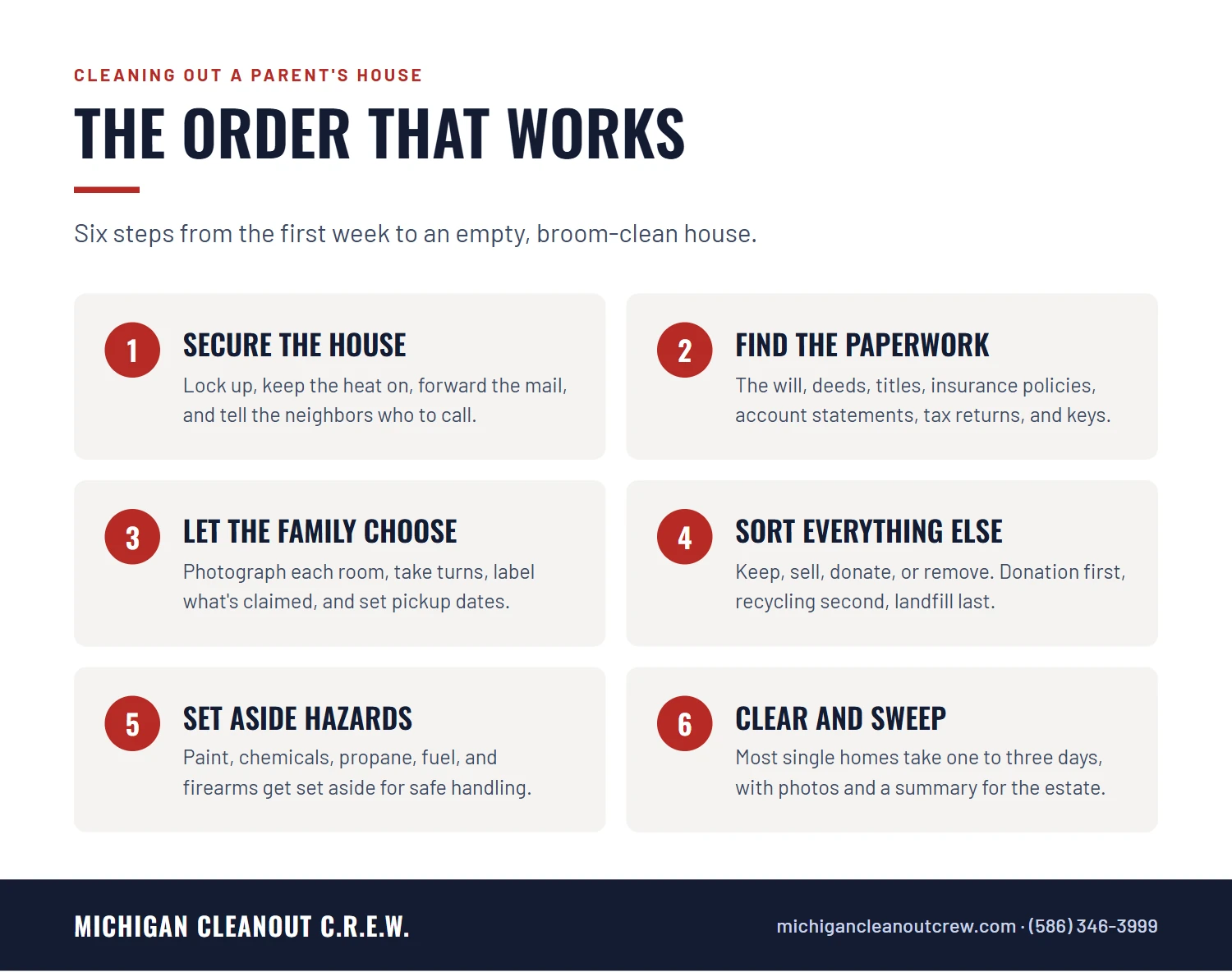
When you’re cleaning out a parent’s house after a death, start by securing the home and finding the important paperwork, then let the family choose keepsakes before anything leaves. The rest of the house can wait until those calls are made.
It’s one of the hardest jobs a family takes on, and the lifting is rarely the hard part. Every drawer has a memory in it, and every decision feels permanent. What follows is the order that tends to work, based on the estate cleanouts our crew handles across Macomb, Oakland, and Wayne counties.
How soon do you need to clear the house?
In most cases, there’s no reason to empty the house in the first few weeks. Give the family time.
The exceptions are real deadlines: a closing date, a lease that’s ending, a house that will sit empty through a Michigan winter, or a safety problem. If one of those applies, plan backward from the date.
While you wait, cover the basics. Lock up, keep the heat on, forward the mail, and let the neighbors know who to call.
If the estate is going through probate, check with the executor or the estate’s attorney before anything of value is sold or given away. Smaller estates can use a simpler process, and Michigan Legal Help’s guide to small estates walks through it in plain English.
$53,000
The most an estate can be worth to use Michigan’s small estate process, for someone who died in 2026. Joint accounts, life insurance, and property held in a trust pass directly to others and don’t count toward it.
Source: Michigan Legal Help, Overview of Michigan’s Small Estate Processes
Owning a house changes the route. The affidavit shortcut only works when the person who died owned no real estate, so a small estate that includes a house goes through the probate court instead.
Where to start: find the paperwork first
Before anyone starts sorting belongings, go looking for documents. The estate will need them, and they’re easy to lose once boxes start moving.
| Document | Why it matters |
|---|---|
| The will, trust papers, and letters of instruction | The will names the executor, and these papers spell out who gets what. |
| Deeds and vehicle titles | You’ll need them to sell or transfer the house and any vehicles. |
| Insurance policies | Life insurance claims, plus coverage on the house while it sits empty. |
| Bank, retirement, and investment statements | They show which accounts the estate has to settle. |
| Recent tax returns and unopened mail | The final tax return, and the bills that need to be paid or stopped. |
| Keys, safe combinations, and written-down passwords | Access to safes, storage units, and online accounts. |
Keep the tax paperwork together. A parent’s final income tax return is prepared much like any other year’s, reporting income up to the date of death, and the IRS guide to a deceased person’s final return covers the details.
Check desks, filing cabinets, closet shelves, and the boxes nobody has opened in years. Papers turn up in strange places, which is why a careful crew sorts instead of shoveling.
If the house is packed floor to ceiling, plan for a slower, room-by-room hoarding cleanout. Documents, cash, jewelry, and photos turn up in almost every one of those jobs.
Let the family choose what to keep
Walk the house together if you can. Photos, letters, recipes, tools, jewelry, and furniture that someone actually wants should be claimed before anything else happens.
If siblings live out of state, a video call while you walk the rooms lets them weigh in without flying home. A few habits keep this from turning into an argument:
- Take photos of each room before anything moves. They help with memories and with estate records.
- Take turns choosing items so no one feels rushed or left out.
- Label what each person is taking and set a date for picking it up.
- Box up anything nobody can decide on yet. It can wait.
How to sort a parent’s belongings: keep, sell, donate, or remove
Once the keepsakes are claimed, everything else goes into one of four piles.
| Pile | What usually goes there | Where it ends up |
|---|---|---|
| Keep | Anything a family member claimed, plus papers the estate needs | Home with the family, labeled, with a pickup date |
| Sell | Furniture, antiques, tools, jewelry, and collectibles with real value | An estate sale, or our vendor and estate sale network |
| Donate | Usable furniture, clothing, kitchenware, and household goods | Donation, with the receipts coming back to you |
| Remove | Broken or worn-out items, old mattresses, and debris | Recycled where possible, hauled away when it can’t be |
Our rule is donation first, recycling second, landfill last. It keeps usable things in the community, and the value recovered can help offset the cost of the cleanout.
Clothing is one of the easiest things to keep out of a landfill, and the EPA’s textile figures show why it’s worth the trouble:
11.3 million
Tons of textiles that went to U.S. landfills in 2018. Only 14.7 percent of textiles were recycled that year.
Source: U.S. EPA, Textiles: Material-Specific Data (2018 figures)
If the house holds a lot of furniture or collectibles, an estate sale may be worth running before the final clear. Our estate sale service handles staging, pricing, promotion on EstateSales.net, and sale day.
Whatever doesn’t sell still has somewhere to go. An estate sale cleanout sorts the leftovers the same way, with resale and donation before anything is hauled.
Set aside hazardous and heavy items
Garages and basements often hold things that shouldn’t go out with a regular load. When our crew finds any of these, we set them aside and help coordinate safe local disposal:
- Hazardous chemicals, paint, and solvents
- Asbestos and biohazard materials
- Propane tanks, fuel, and oil
- Firearms and ammunition
Heavy items are part of the job too. Pianos, organs, appliances, and exercise equipment come out with everything else, along with hot tubs and sheds.
On a full house, we coordinate 10 to 40 yard roll-off dumpsters sized to the job and swap them as they fill. The full list of what a property cleanout covers runs from the attic to the swing set out back.
Cleaning out a parent’s house from out of state
Many of the families we work with aren’t local, and that’s fine. The walkthrough can happen in person or by video, and the cleanout itself can run from a lockbox code.
One recent job was a completely full house inherited by a daughter who lived out of town. She’d been trying to find her father’s urn and wasn’t hopeful. We found it, along with her parents’ marriage certificates.
You get photo updates at each decision point, so nothing leaves without your say. When it’s done, before-and-after photos and a completion summary are available for estate records or the attorney handling probate.
If the house is headed for a listing, tell us the photo date. We’ll work backward from it, the same way we handle market-ready home prep for agents and sellers.
How long does it take to clear a parent’s house?
Once the family’s decisions are made, the cleanout itself moves quickly. Here’s how the schedule usually runs with our crew:
| Step | Typical timing |
|---|---|
| Free walkthrough, in person or by video | Usually within a few days of your call |
| Flat-rate quote | After the walkthrough, based on volume, access, and labor |
| Cleanout starts | Most projects begin within the week after you approve the quote |
| Garage or single room | Often done the same day |
| Most single homes | One to three days |
| Closing or listing deadline | Gets priority on the schedule |
The walkthrough is free, and the flat-rate quote you get afterward is the number on the invoice.
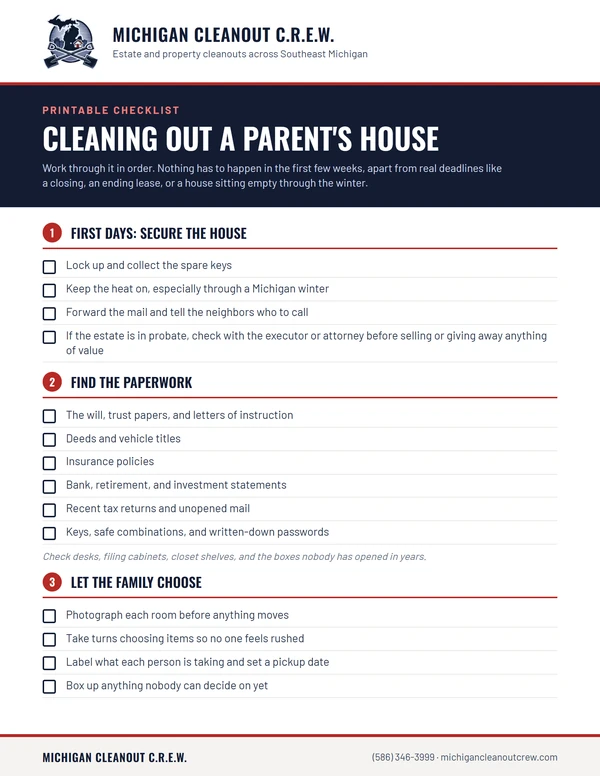
Free printable checklist
Every step in this guide on two printable pages, with boxes to check off. Keep a copy for the family, or hand one to the executor.
What a bereavement cleanout service handles
A bereavement cleanout is the same job some families call an estate cleanout or inherited property cleanup. Our estate cleanout service runs in four steps:
- Free walkthrough. We walk the property with you, in person or by video, and talk through what stays, what goes, and what matters.
- Flat-rate quote. One clear number based on volume, access, and labor. The quote is the price.
- Sort and clear. Keepsakes first, then donations and resale items, then full removal, room by room until the house is empty.
- Final sweep. A broom-clean finish with photo documentation, so the property is ready for whatever comes next.
Our before-and-after gallery shows real rooms our crew has cleared, with nothing staged. If you only need a few big items hauled off, that’s a smaller job, and our guide to whole-house cleanouts versus junk removal explains the difference.
I wish I could give more than five stars. I was really overwhelmed with the task of cleaning out my father’s house. I had contacted Zach and he was really great to work with. I thought the price was really fair! Zach and his crew did an amazing job. Just the whole experience to me was smooth. Zach communicated with me throughout it the entire team. If you need a cleanout do not hesitate to call. You will be very pleased with the results!
Krystle Lundahl · Estate cleanout · August 2026
Cleaning out a parent’s house: common questions
What is a bereavement cleanout?
It’s the work of clearing a home after someone dies, sometimes called an estate cleanout or inherited property cleanup. What sets it apart from a haul-away is the sorting: keepsakes and documents are set aside first, and anything with value or use is sold or donated before the rest is removed.
What does an estate cleanout cost?
Most Southeast Michigan estate cleanouts land between a few hundred dollars for a single room and a few thousand for a full house. Your exact number comes from a free on-site walkthrough, and the flat-rate quote is the number on the invoice.
Do we need to clear anything before the walkthrough?
No. The walkthrough works best when we see the house as it is, so the quote reflects the real volume. Point out anything the family has already claimed, and we’ll plan around it.
What if family members disagree about what to keep?
Box up the disputed items and set them aside so the rest of the work can go on around them. We move at the pace the family needs, and nothing leaves the house without a decision.
Get a free on-site walkthrough
Tell us a little about the property and we’ll set up a free on-site walkthrough. No pressure, no obligation, and a clear flat-rate quote.